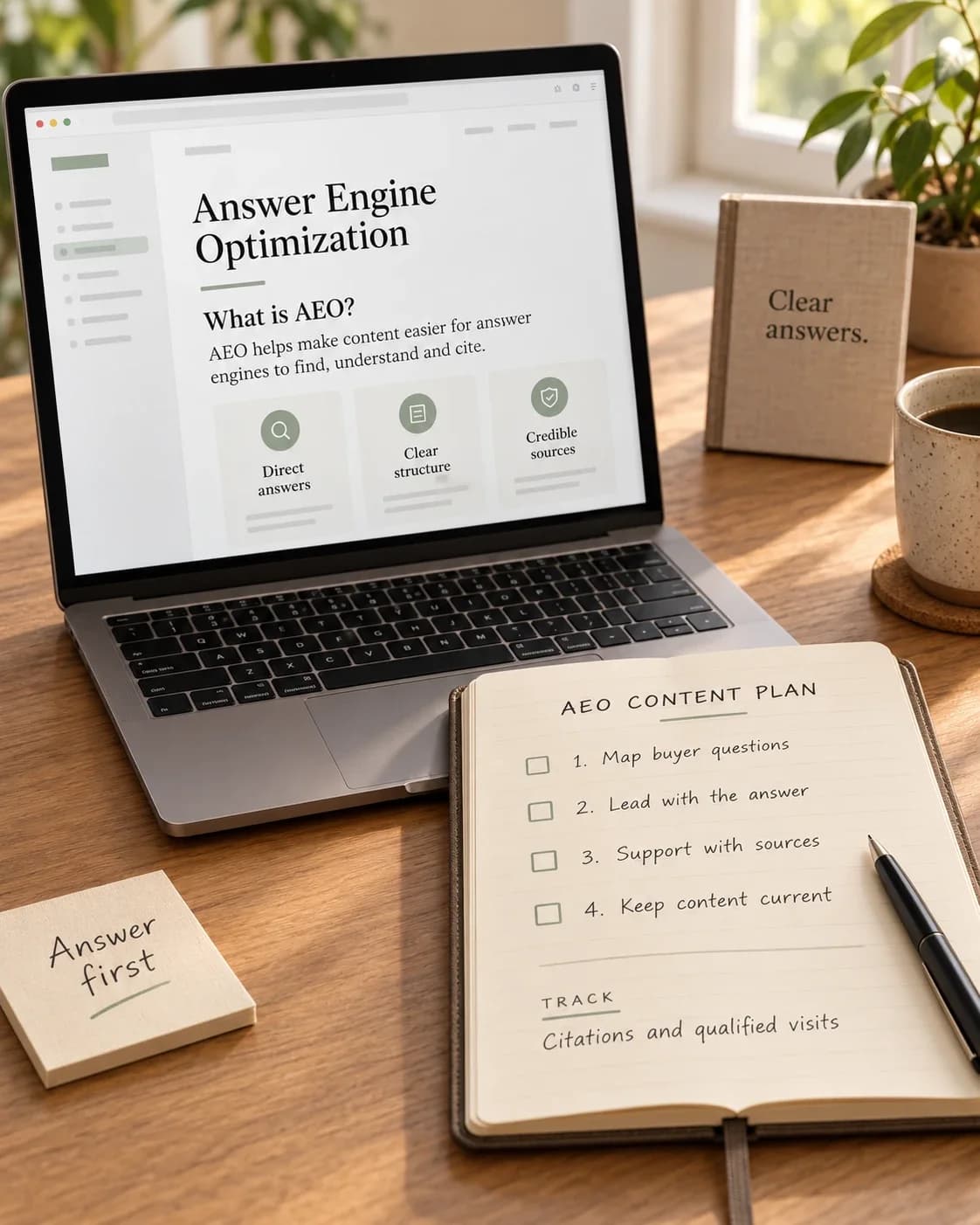
Buyers now ask ChatGPT, Perplexity, Gemini and Google's AI for software shortlists. This playbook covers how each AI tool finds sources, the on-site and off-site work that gets your brand named, and how to measure AI visibility every month.
If you're new to the terms, start with what AEO is and GEO vs AEO vs SEO. This playbook goes further: it explains how the main AI tools work, what to do on your site and off it, and how to build a monthly routine that improves your visibility over time.
Why AI search matters for SaaS
Buying journeys used to start with a search and ten blue links. Increasingly they start with a question to an AI assistant: "What's the best tool for X for a team like ours?" The answer names a handful of brands. Those brands make the shortlist; the rest may never get a visit. Even on Google, AI Overviews answer many questions before anyone clicks, leading to more zero-click searches.
How AI tools find and choose sources
Most AI assistants answer from a mix of training data and live search. When they search, they use retrieval-augmented generation: fetch relevant pages, then write an answer from them. In practice:
- ChatGPT can search the web for current questions and shows sources it used.
- Perplexity searches for almost every question and cites its sources prominently.
- Google AI Overviews and AI Mode draw on Google's own index, so classic SEO matters directly.
- Gemini, Claude and Copilot combine training knowledge with web results in different ways.
The common thread: pages that rank, that state answers clearly and that come from brands the web describes consistently are the ones most likely to be quoted.
On-site work: make your site easy to read and quote
Technical access
- Allow the AI crawlers you want citing you in robots.txt and your firewall.
- Render important content in HTML, not only via JavaScript.
- Publish an llms.txt file summarising your company, services and key pages.
- Add schema markup: Organization with sameAs links, products, articles and FAQs.
Answer-first content
- Put the direct answer in the first one or two sentences of each page and section.
- Use question headings that match how buyers ask, including conversational search phrasing.
- Include specific, checkable facts: pricing logic, integrations, who you're for and not for.
- Write honest comparison pages; AI tools rely on them when building shortlists.
Clear entity information
Make it unambiguous who you are. One brand name, one category description, the same facts on every page. If your name resembles another company's, say clearly what you are and aren't. This is entity SEO, and it's often the fastest fix for AI tools describing you wrongly.
Off-site work: be mentioned where AI tools look
AI answers lean heavily on third-party sources. What others say about you often matters more than what you say yourself:
- Claim and complete profiles on the review sites for your category, and ask customers for reviews.
- Get included in the "best tools" lists and comparison articles that rank for your category.
- Earn coverage with original data or expert commentary through digital PR.
- Contribute to podcasts, newsletters and community discussions your buyers follow.
- Keep LinkedIn, Crunchbase and directory listings consistent with your website.
Start by checking which sources AI tools cite for your category's questions. Those pages are your outreach list. Backlinks from them help search rankings too.
Measure AI visibility every month
You can't manage what you don't track. Set up a simple, repeatable process:
- Write 15 to 30 questions your buyers ask, from "what is [category]" to "best [category] for [segment]".
- Ask each one in ChatGPT, Perplexity, Gemini and Google AI Mode on a fixed day each month.
- Record whether you're named, your position, how you're described and which sources are cited.
- Calculate your AI share of voice: the share of answers that name you.
- Track AI citations of your pages, and AI referral visits in analytics.
Answers vary from day to day, so look for trends over months rather than reacting to single results.
Don't forget classic SEO
AI search builds on search. Many AI tools retrieve pages through search indexes, so strong rankings feed AI visibility directly. If your SEO foundations are weak, start with our SaaS SEO guide. Formats that win featured snippets and People Also Ask boxes also tend to be the passages AI tools quote.
A 90-day AI search plan
- Weeks 1 to 2: baseline your AI visibility with a question set; audit crawler access, schema and entity consistency.
- Weeks 3 to 6: rewrite key pages answer-first, add FAQs, publish llms.txt and fix brand descriptions everywhere.
- Weeks 7 to 10: publish comparison pages and one piece of original data; start outreach to the sources AI tools cite.
- Weeks 11 to 13: re-run the question set, compare with baseline and set next quarter's priorities.
For a shorter checklist, see how to get cited by ChatGPT. For definitions, browse the AI search section of our glossary, starting with answer engine optimization.
Platform by platform: what to check
ChatGPT
Ask your buyer questions with search enabled and note the sources it lists. Make sure OAI-SearchBot can reach your site, your pages are indexed in the major search engines and your key facts are stated plainly on your own pages.
Perplexity
Perplexity cites sources for almost every answer, which makes it the easiest tool to learn from. Study which pages it cites in your category: these are often comparison articles, review sites and well-structured guides. Aim to appear on those pages, and to publish your own versions.
Google AI Overviews and AI Mode
Google's AI features draw on its own index, so classic SEO matters directly. Pages that rank on the first page, answer questions concisely and use clear structure are the most likely sources. Track which of your target searches show an AI Overview in Search Console impressions and in manual checks.
Gemini, Claude and Copilot
These tools mix training knowledge with web results. Consistent brand information across many sites, and a presence on trusted publications, matters most for how they describe you when they don't search.
Content formats AI tools quote most
- Definitions: a one or two sentence answer that stands on its own, like the opening of each glossary term.
- Comparisons: clear tables or lists of differences, with who each option suits.
- Step-by-step guides: numbered steps with specific actions.
- Lists of options: "best tools for X" with honest criteria.
- FAQs: short questions and direct answers, marked up with schema.
- Original data: specific findings with a clear method, which others then repeat.
Fixing wrong or outdated AI answers
If an AI tool describes your product wrongly, such as old pricing, a discontinued feature or confusion with another company, trace the source:
- Check which pages the tool cites, if it shows sources.
- Update or correct those pages, starting with your own and your profiles.
- Ask third-party sites with outdated information to update it.
- Publish a clear, current page on the topic, such as pricing or a comparison.
- Re-check monthly; tools that search live often update within weeks.
Reporting AI visibility to leadership
Keep the report simple: your share of AI answers for the question set, the trend over time, how you're described compared with competitors, the top cited sources and the actions planned next. Pair it with pipeline data, including AI referrals and buyers who mention ChatGPT or Perplexity on demo forms.
Frequently asked questions
Not in organic answers. Visibility is earned through clear content, consistent brand information and mentions on trusted sources.
It builds on SEO but adds a focus on quotable answers, entity consistency and third-party mentions. The two work best together.
Fixes to access, content and entity information can show within weeks in tools that search live. Reputation-driven mentions take a few months.
The one your buyers use most. In practice the same work helps across ChatGPT, Perplexity, Gemini and Google's AI features.