Organoid Programming
A real-time 3D website for biocomputing startup Organoid Programming
- Industry
- Biocomputing
- Timeline
- 2026
- Website
- organoidprogramming.com
The challenge
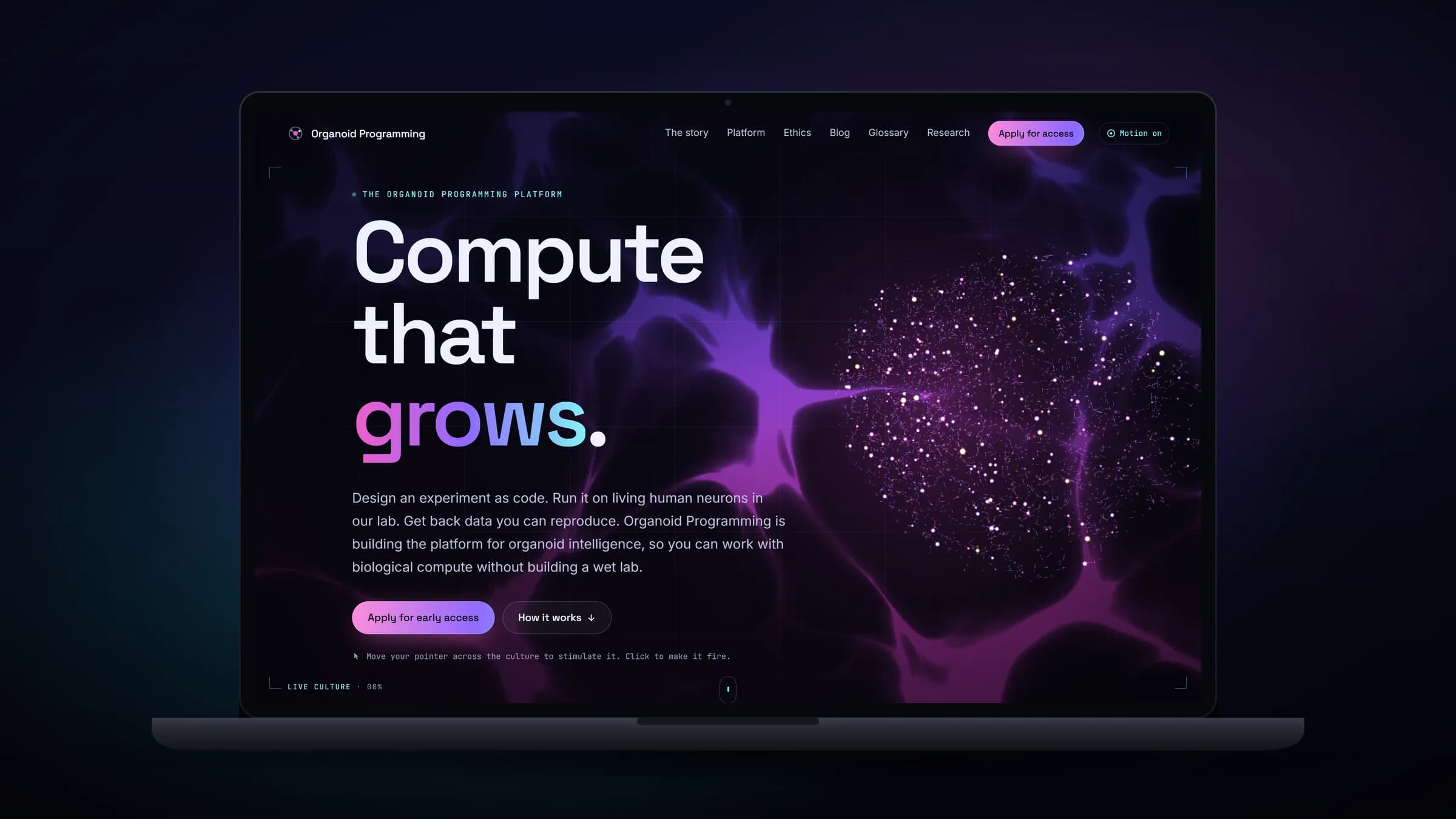
Organoid Programming is building software that lets researchers run experiments on living human neurons. The idea is new and abstract, and most visitors, from investors to engineers, have never seen a brain organoid. The company needed a site that could explain the science quickly and honestly.
The site also had to work for very different readers: neuroscience labs, drug-discovery teams, AI researchers, investors and future hires. And it had to avoid hype, because claims about living neurons attract scrutiny.
The strategy
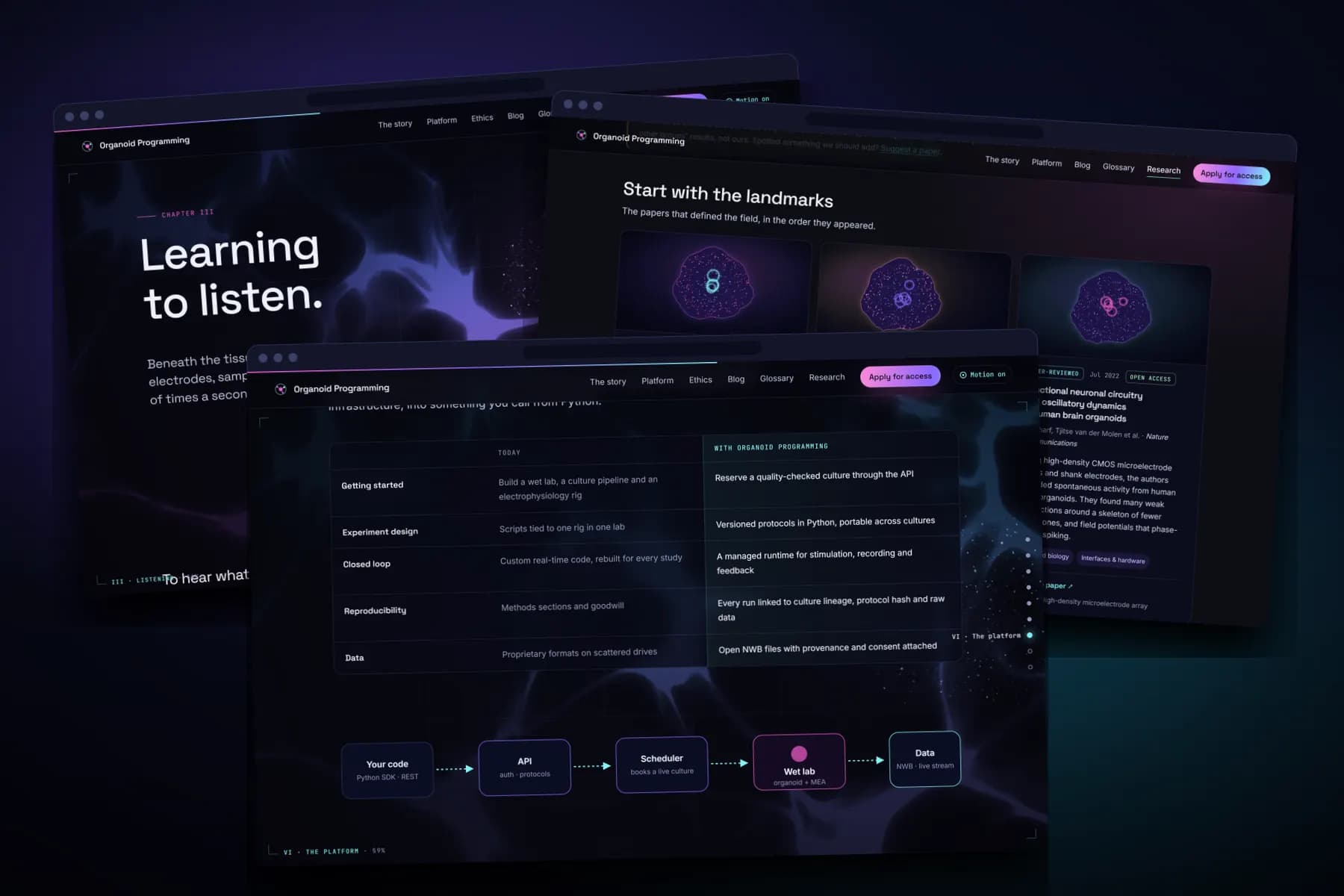
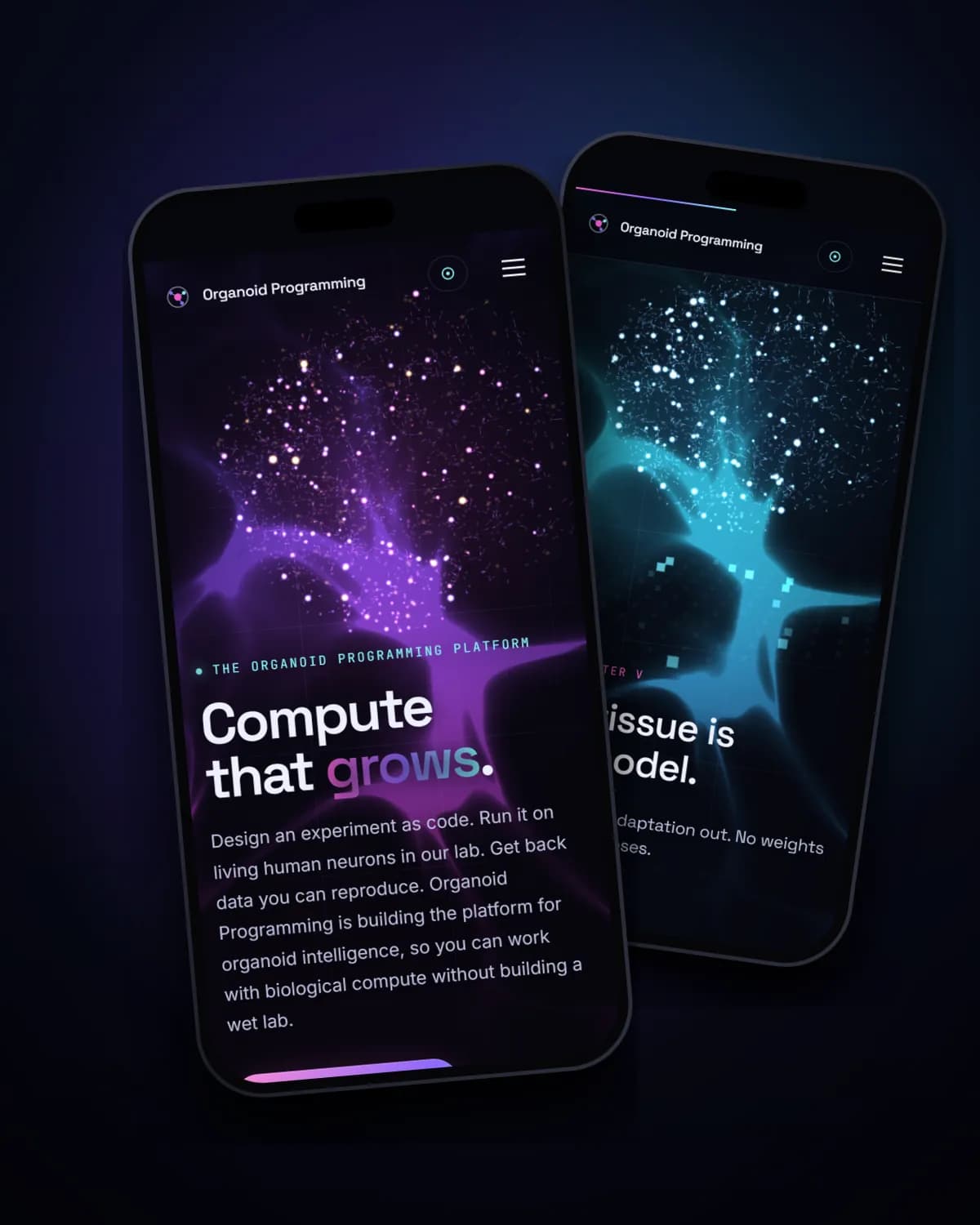
We made the first screen a real-time Three.js organoid that visitors can stimulate with their pointer, so the core idea is felt before it is read. The rest of the homepage is a chaptered story that walks from the energy cost of AI to how organoids are grown, recorded, stimulated and trained, with the 3D scene changing at every chapter.
We kept it credible by sourcing every number, checking every academic citation against Crossref and leaving out anything we could not verify. Then we built a content base of guides, a glossary and a research library, so the site can earn search and AI-answer traffic for the whole category.
The execution
- 1
Messaging before design
We wrote a messaging framework covering positioning, audiences, proof rules and boilerplate, then built every page against it.
- 2
A living first screen
A custom Three.js scene with about 2,600 neurons, travelling synaptic pulses and a shader background that responds to pointer, touch and scroll.
- 3
Fast, accessible fallbacks
The 3D loads after the page is ready and lowers its resolution when needed. Reduced-motion and low-power visitors get a static illustration.
- 4
Content for search and AI
We wrote 14 guides and essays, 45 glossary entries and a 50-paper research library, with structured data, llms.txt and a sitemap.
- 5
Launch and handover
We set up Vercel hosting, Cloudflare DNS, email forwarding and a private early-access form, plus a monthly research update workflow.
The results
- At launch, including 14 guides and 45 glossary terms
- 64 pages
- Largest Contentful Paint on mobile (Lighthouse lab test)
- 2.1 s
- Lighthouse accessibility and SEO, mobile and desktop
- 100 / 100
Services used
Next case study
SRD Hummer Auto Group: A launch website for an electric off-roader, HummerX